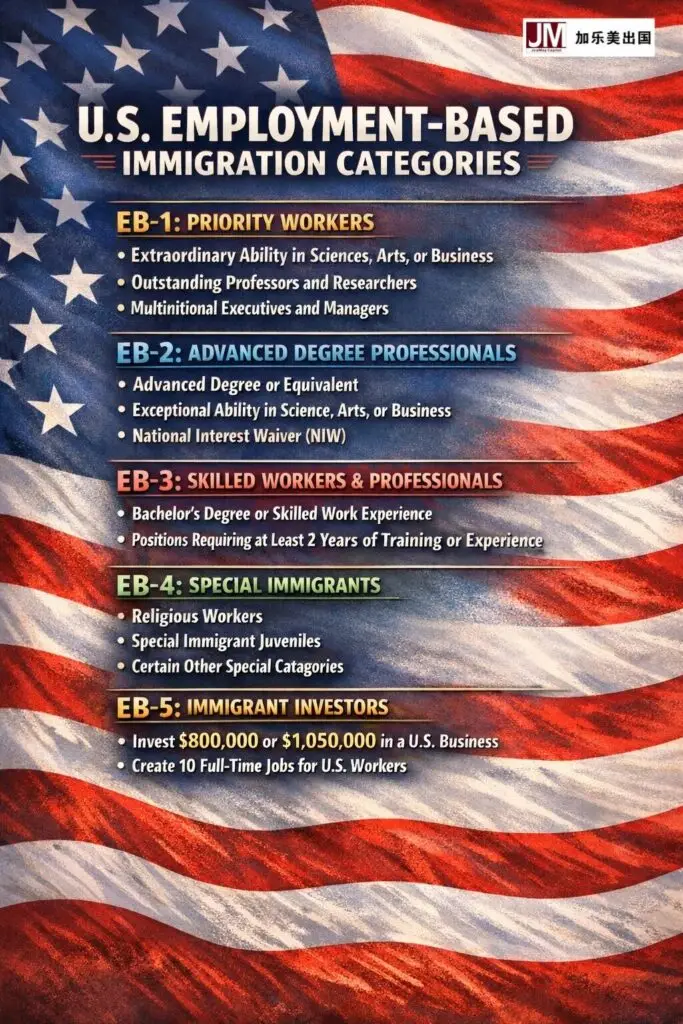
US to launch wage-weighted H1B lottery
Just after Trump took office for his second term, the H-1B visa became a focal point of online controversy. Elon Musk has consistently argued for the importance of the H-1B visa, while many Americans commented that foreigners using H-1B visas were taking jobs from Americans. The H-1B quota is nationally unified, not allocated by state. Annual total quota: 85,000. Regular Cap: 65,000. Advanced Degree Exemption: 20,000.
Starting in March 2026 (the application period for H-1B visas in 2027), USCIS will implement new rules for H-1B visas, changing from an initial one-person-one-lottery system to a salary-weighted lottery.
I. What is “Salary-Weighted” Selection? After the DHS (U.S. Department of Homeland Security) changed the H-1B lottery for fiscal year 2027 to a salary-weighted selection, each registrant is not selected only once, but is repeatedly added to the lottery pool according to their salary level:
Level I → 1 selection
Level II → 2 selections
Level III → 3 selections
Level IV → 4 selections The system randomly selects based on the total number of votes from all registrants. The estimated probabilities of selection for different salary levels (OEWS Level I–IV) are as follows:
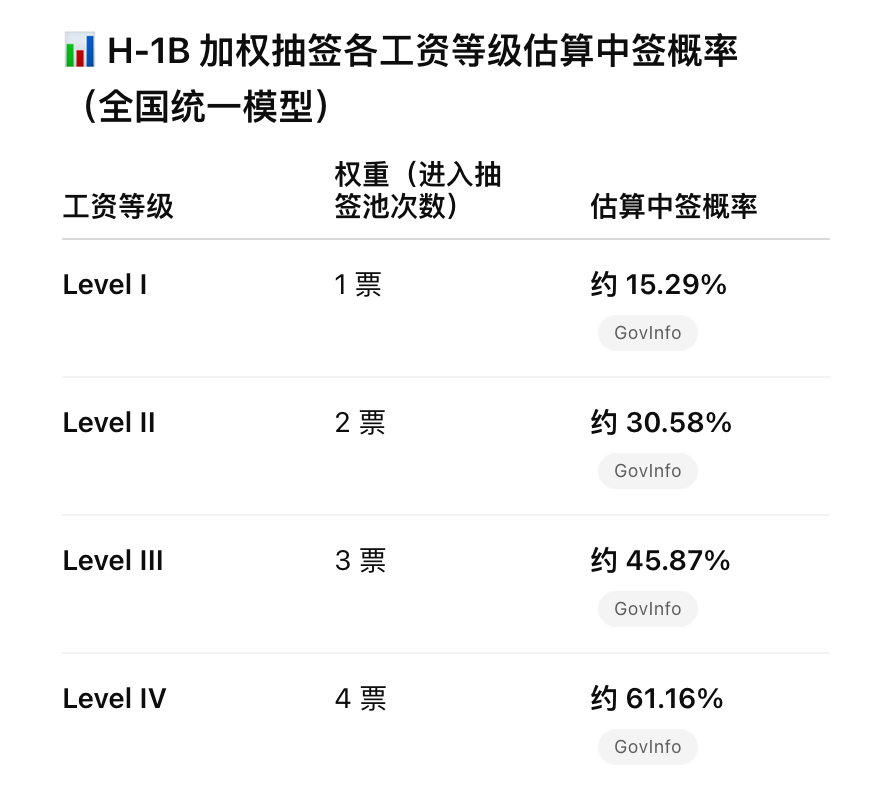
This means: the probability of being selected for high-paying positions increases significantly but is still not 100%; the probability of being selected for low-paying or entry-level positions decreases; those with higher skills and salaries have a more significant advantage; and wage level calculations differ from state to state.
II. How to Check the Specific Wage Level of a City (to Further Estimate the Success Rate) To obtain a more accurate probability of success for a city, you need to: ✅ Find the Prevailing Wage Level for the applied position in the U.S. Department of Labor’s OEWS database. This will show the specific value for the four wage level thresholds corresponding to that occupation in New York, Los Angeles, and Dallas. Official data retrieval portals are usually the DOL FLC Wage Data Center (enter region + position) or third-party tools. Then you can see which wage level corresponds to which city. Common tools include: OEWS Wage Data Center, and the statistics interface of myvisaservices. ✅Example: The same job in Dallas and Los Angeles: Software Engineer, annual salary $300,000. 📍Dallas: Level IV 📍Los Angeles: Level IV 🎯In the 2027 fiscal year H-1B weighted lottery—the odds of winning are 【exactly the same】👉 Neither has a higher probability.
As long as both are in the highest salary category, Level IV, the lottery weighting is the same. Of course, the target values for the highest salary category, Level IV, are not exactly the same in different states, but you can think about it this way: the companies that offer high salaries for H-1B visas are still mainly large companies, and the locations of these large companies are actually still in a relatively fixed number of cities: New York, Boston, San Francisco, Los Angeles, Austin, Dallas, etc. III. Are salary levels different in different states? Yes, salary levels (Prevailing Wage) vary depending on geographical location and occupation. Standard basis: H-1B salary levels are determined based on OEWS (Occupational Employment and Wage Statistics) data from the Department of Labor (DOL), and include four levels. Geographical Differences: For the same position (e.g., “Software Engineer”), the Level 1 salary in a high-cost-of-living area (such as San Francisco, California, or New York City) may be higher than the Level 2 or even Level 3 salary in a low-cost-of-living area (such as a city in Iowa). Selection Criteria: The lottery weighting is calculated based on the salary level (I-IV) of the specific area of intended employment, not on the absolute amount. Example: If you earn $100,000 in New York, it might only be Level 1, but in some Midwestern states, $100,000 might be Level 3. In this case, applicants in Midwestern states would have 3 chances in the lottery, while those in New York would only have 1.
IV. 2026 H-1B Application Timeline (Estimated)
Registration Open: March 2026 (specific date to be announced by USCIS)
Registration Deadline: Mid-to-late March 2026
Notification of Selection: Usually March–April
I-129 Formal Petition Submission: April–June
H-1B Status Effective: Generally from October 1, 2026 (if approved)
V. H-1B Applicant Eligibility Requirements
Whether applying from within or outside the United States, basic H-1B eligibility requirements include:
✔ Educational Requirements
Applicants must possess a U.S. bachelor’s degree or equivalent international degree (or higher) directly related to the job requirements. Some positions have specific requirements regarding degree major/field.
✔ Specialty Occupation
The position must typically require skills in a professionally relevant field, such as IT, engineering, accounting, scientific research, etc. ✔ Employer Qualifications: The employer must be a genuinely operating U.S. company; must be able to undertake actual work and pay compliant wages; and must pass a wage compliance review through a Labor Conditions Application (LCA). 🚫 Those without a degree or in non-specialized positions are generally ineligible to apply for H-1B visas.
VI. Differences between H1B domestic and overseas applications
| Category | Change of Status (COS) (In-U.S. Status Adjustment) | Consular Processing (CP) (Overseas Consular Procedure) |
|---|---|---|
| Applicable Group | In U.S. with valid status (e.g., F-1 OPT) | Overseas; or in U.S. with expired status/choosing to depart |
| $100k Golden Add-on Fee | $0 (Waived) | $100,000 (Mandatory) |
| H-1B Registration Fee | $215 (Paid during lottery) | $215 (Paid during lottery) |
| I-129 Base Fee | $780 (Large co.) / $460 (Small co./Nonprofit) | $780 (Large co.) / $460 (Small co./Nonprofit) |
| Anti-Fraud/Education Fee | ~$1,250–$2,000 (Scale-dependent) | ~$1,250–$2,000 (Scale-dependent) |
| Premium Processing Fee | $2,805 (Optional; 15-business-day result) | $2,805 (Optional) |
| Effective Process | Automatic switch: Status becomes H-1B on 10/1 | Consular interview + entry: Takes effect post-stamping/entry |
| Entry/Exit Restriction | No departure before approval (abandons status if violated) | No restriction (already overseas/preparing to depart) |
| Risk | Need valid U.S. status during RFE period | Administrative Check may delay re-entry |
VII. Family Benefits for H-1B Visa Holders As an H-1B holder, your family members enjoy comprehensive benefits.
- Visa Type: H-4 Visa: This visa is specifically issued to the spouse and unmarried children under 21 years of age of the H-1B holder. Validity: The validity period is exactly the same as the H-1B holder’s visa (linked).
- Spouse Employment (H-4 EAD): The spouse cannot legally work “immediately” after entry; specific conditions must be met and an EAD (Employment Authorization Document) must be applied for. Application Requirements (One of two): The H-1B holder’s I-140 immigrant petition has been approved (this usually means the green card process is in progress). The H-1B holder has received an H-1B extension of more than 6 years under AC21. Work Restrictions: Once the EAD is obtained, the spouse’s work is not subject to any restrictions. They can work for any employer (unlike H-1B visas which require a specific professional background), full-time or part-time, and even start their own businesses or work as freelancers. Note: Only the spouse can apply for an EAD; children holding H-4 visas cannot work in the U.S.
- Children’s Education in Public Elementary and Secondary Schools: H-4 children enjoy the same rights as U.S. citizens and green card holders, and can attend local public elementary to high school (K-12) for free. Admission Rights: According to a U.S. Supreme Court ruling (Plyler v. Doe), public schools cannot refuse admission to students based on their immigrant status. College Education: Children can attend college on H-4 status. In many states, H-4 students can enjoy “in-state tuition” after residing in the state for a certain period, which is significantly cheaper than tuition for international students (F-1). Note the risk of “aging out”: Children will lose their H-4 status after turning 21. If a green card is not yet available by then, children will need to switch to F-1 student visas to remain in the United States.
In summary, the H1B visa lottery for 2027 will still begin in March of the previous year (March 2026 this year). The quota remains the same; what changes are the rules and fees. The lottery is weighted by salary, with higher-salary applicants having a higher probability of being selected. Lower-salary applicants still have a chance, but the success rate has decreased from an average of 28% for applicants at salary level four to 15.29%. Furthermore, each state has slight differences in how the four salary levels are defined for developed and less developed states. The same salary might be level four in a less developed state but level two or three in a developed state, thus affecting the success rate. However, upon closer examination, are you striving for a permanent green card? No, it’s just a 6-year non-immigrant visa. For applicants in the immigration queue, it allows them to enter the United States earlier to work and live. For applicants not yet in the immigration queue, it provides a temporary visa for living in the US, but they still need to consider whether they need and meet the requirements for US immigration. Each H1B visa is valid for a maximum of six years, after which a new H1B application can be submitted. The H1B visa is not an immigrant visa; it is a time-limited non-immigrant visa. During the time you work in the US, your H1B employer can sponsor your immigration, or other employers can sponsor you through other immigration pathways. However, whether an employer sponsors you or whether you meet the immigration requirements are not directly linked to the H1B visa (Hard-Low). (inking). The new H1B policy in 2026 is most suitable for international students in the US or applicants holding valid visas in the US. After all, the $100,000 fee for overseas applicants is only for the very wealthy; most people would simply apply for immigration directly! This March, the US H1B visa process changed. It’s no longer a one-person-one-lottery lottery, but a salary-weighted lottery. Who benefits, and who faces greater difficulty? Do you need a student visa, an H1B visa, or a green card? Figure out what you need. Jialemei welcomes clients to consult about H1B visas. We can provide US headhunting services, legal services for H1B visa filing, and immigration application services. We wish everyone success in their 2026 H1B applications.